
Products
Solutions
Resources


The updates I’m sharing today were talked about in our recent Monthly Product Webinar, which we just restarted on October 5th. The next one is November 5th.
The vision behind Statsig is simple: We want to help you increase the rate of your learning as your speed of shipping accelerates. As AI and coding agents help teams build faster, you can put more changes in front of users than ever before. But shipping a change is only part of the job.
You also need to understand whether it made the experience better. And you need to use that understanding to decide what to build next, hopefully harnessing as much signal as possible from those learnings so we can make the greatest impact possible.
We’ve been working on some bigger Statsig features to do just that: make it easier to scale your testing practices alongside the pace of development. These new features will help you bring experimentation into the workflows where you already build, reduce the manual work involved in running tests, and make testing a more natural part of shipping across both deterministic and agentic features that you build.
Statsig MCP v3
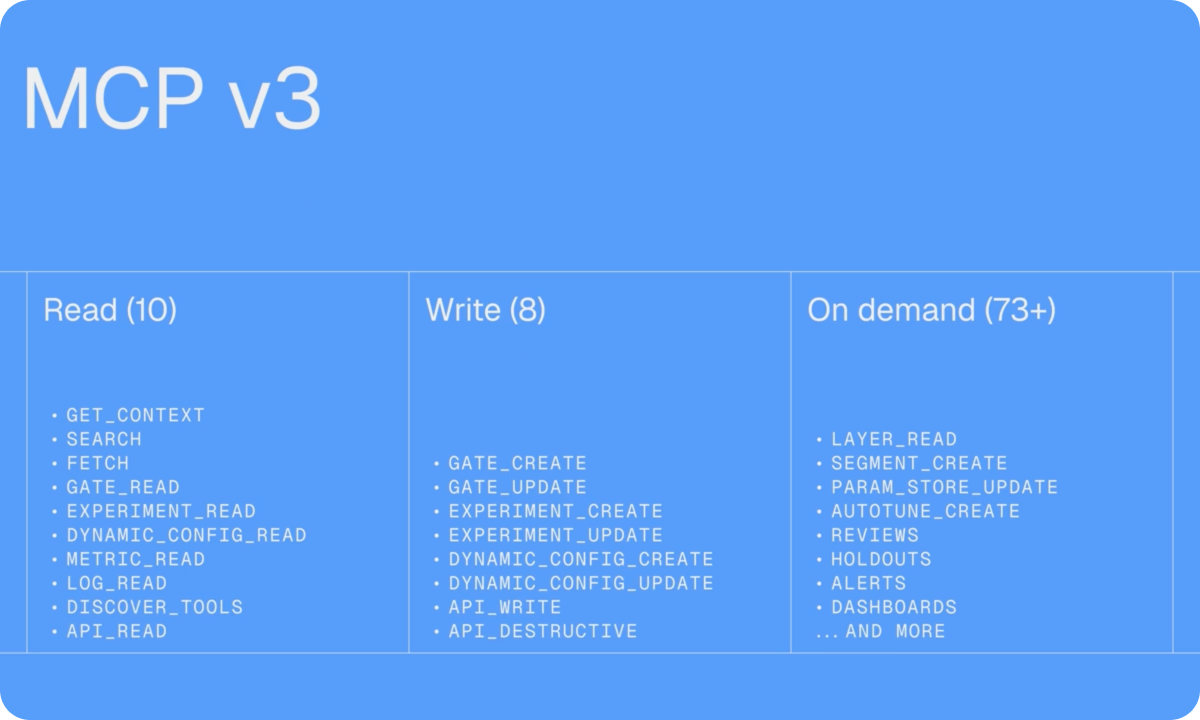
We just launched a new version 3 of the Statsig MCP. Madelyn Tarr, the PM lead, has a great write-up of everything it can do, and Harman Kaur, the Eng lead, has a deep dive coming up on the technical decisions that went into creating it. This new version is a big enough deal that I wanted to make sure to call it out here, too.
This version has full parity with the Console API. Anything you can do with the API, you can now also do with any agent.
But just as importantly, we’ve made the Statsig MCP safer to use and more efficient. It has granular permissions for roles and users to make sure your teammates and their agents can take the actions you want them to, and it operates with 43% fewer tokens than v2.
We’ve seen a lot of read use-cases with the MCP, and we hope this safer and more efficient version will encourage more write cases, like gate and experiment creation, so you don’t have to hop between surfaces. As we add more features to the Statsig Console, we’ll continue to incorporate them into the MCP and API so you can learn better on whatever surface you prefer.
For more on how to use MCP v3, check out our docs.
Stale dynamic config management
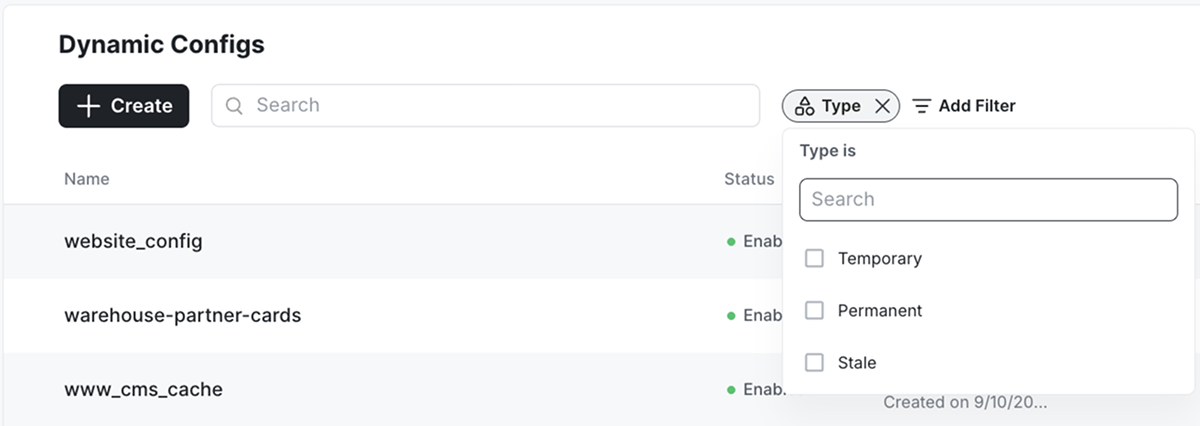
We’ve ported the logic of stale management from feature gates over to dynamic configs to make it easier to streamline and clean up your codebase.
Previously, you’d be notified if feature gates grew stale, meaning that they weren’t being actively used. However, dynamic configs could have the same stale state but didn’t have a method of alerting you. A gate that started during a release that got rolled out to 100% would continue to linger if nobody remembered to prune it.
Now, a config will automatically alert you that it could be stale. This happens if it meets three criteria: it doesn’t have a permanent or archived state, no active gates or experiments reference it, and nobody has touched it recently. The alert recommends turning the config permanent or archiving it, making it easy to maintain your configs in the Feature Management tab.
Learning works best in a clean environment. We hope this will help you keep your codebase tidier.
Agent experimentation
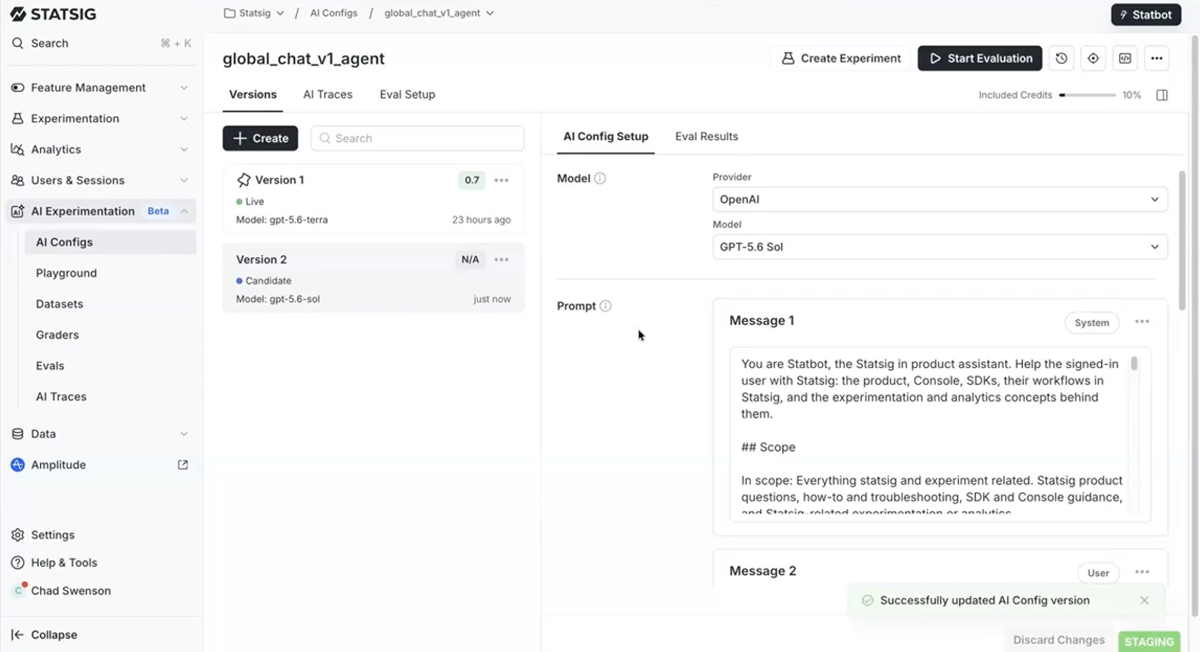
In our webinar, we also discussed Agent Experimentation. This set of features proves that every AI change has real business impact by running a full evaluation loop from offline and online evals to a real experiment, so your team ships AI on proof instead of gut feel.
First, you can configure your AI agents with AI configs, so you and your team can collaborate on different versions of the agent to test. Then, you can run offline and online evals, using LLM judges and traces from user interactions to assemble a golden dataset. Finally, you can run A/B tests on business metrics to prove the impact of your agent designs.
Just like you, we’ve been building a lot of agentic features, and we know firsthand that agents need qualitative measurement from evals alongside causal impact on product and business metrics. We’re excited for Agent Experimentation to help teams building agents learn about and improve their non-deterministic features.
The agentic Statsig experience
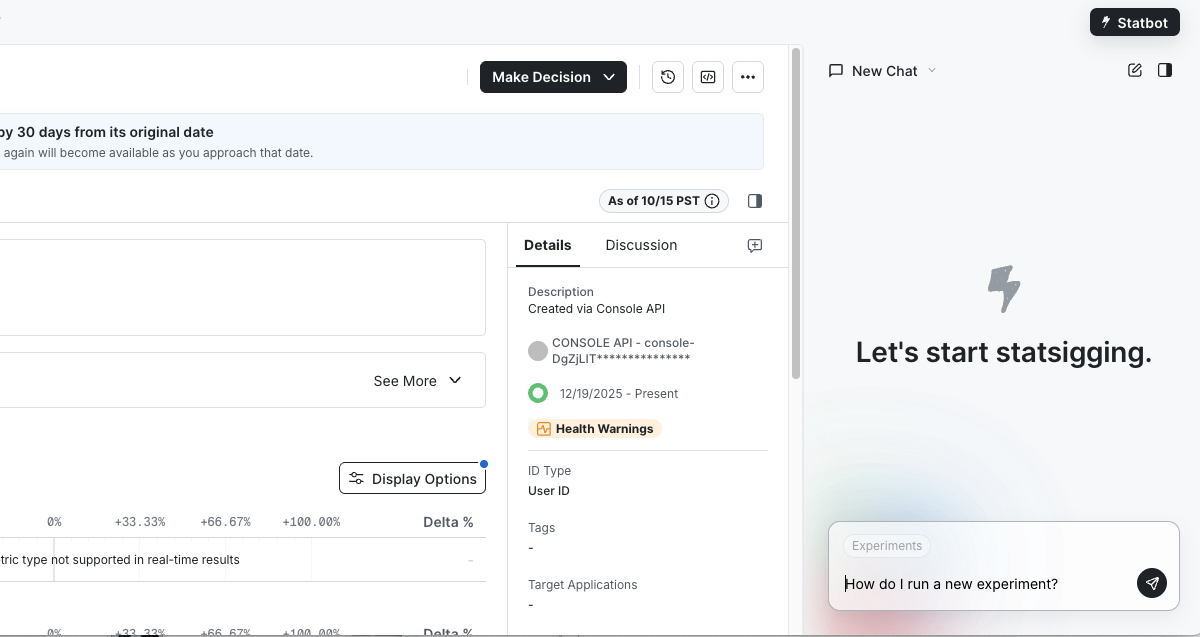
Along with MCP’s outside-the-console agent experience, we’ve been building Statbot, a new agent experience inside Statsig itself.
The aim with Statbot is to make the core Statsig experience easier for anyone on your team to set up experiments and learn. The current Statsig chatbot can answer questions and link you to docs, but we’ve heard you want it to do more, and we want that too. Statbot will be agentic, meaning it can eventually act for within Statsig just by chatting with it.
Statbot is currently in beta with read-only access, and we’re excited to get more feedback on it. Let us know if you’d like to try it!
The next episode
October is well underway, and there’s more to come with how Statsig makes it easier to learn better and scale your testing practices.
To be the first to know, sign up for our next Monthly Product Update webinar. It’s just around the corner on November 5th. I’ll be presenting along with other PMs and engineers on the Statsig team, with time for Q&A at the end.
Otherwise, check back here for the next recap post.